

























Plinko has become a familiar sight in online casinos since its 2019 release. The game asks little more than a click, a falling ball, and a board full of pegs, yet it offers a surprisingly wide range of risk settings and multiplier outcomes. For newcomers, the demo mode makes it easy to learn the rhythm without spending anything, while real-money players can explore welcome bonuses that reach up to $9,500 for crypto deposits or $2,800 for card payments at some licensed operators. This guide covers the mechanics, the role of risk and row count, and practical ways to approach the game.
The Core Mechanics of a Plinko Drop
Plinko is an instant-win game rather than a slot or table game. You set a stake using the plus, minus, minimum, and maximum controls, then release a ball from the top of a peg-filled board. Gravity and probability do the rest, sending the ball through a series of bounces until it settles in one of the multiplier pockets at the bottom. Your payout is simply your stake multiplied by the number that pocket shows. A $5 bet that lands on a x12 multiplier, for example, returns $60. The betting range runs from $1 to $100, and the game supports both desktop and mobile play with no downloads required. Crypto deposits are accepted, and the advertised return to player can reach as high as 99.00%.
Risk Levels, Rows, and the Shape of Volatility
Before each drop, you choose a risk level: low, normal, or high. Low risk brings frequent but smaller wins with minimal swings. Normal risk balances how often you win against the size of the multipliers. High risk turns up the volatility and opens the door to the game’s maximum win of x1000. You also select a row count between 8 and 16. A higher row count produces more bounces and stretches the multiplier layout wider, which generally increases volatility. The layout of multipliers is built around a probability curve, so results stay random even when patterns seem visible. Raising risk and adding rows tends to make the curve wider and the session more volatile. The x1000 pocket remains available in every mode, but it is never a common result. Many experienced players pair high risk with 14 or 16 rows to chase the top prize, accepting that the ride can be rough.
Demo Mode Versus Real-Money Play
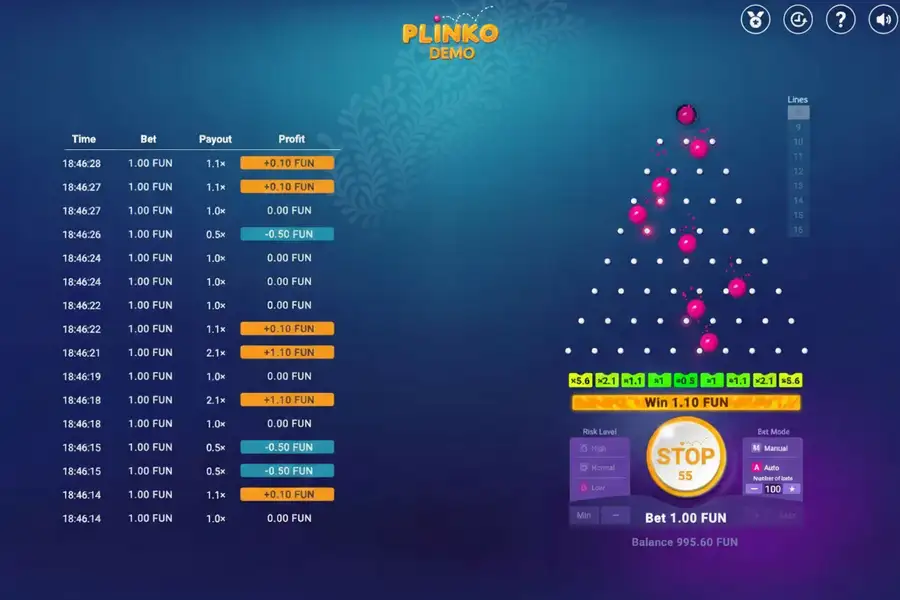
The demo mode is one of Plinko’s most useful features. It lets you test risk levels, row counts, and manual or auto play without risking a cent. Because there is no download, you can open the demo in a browser and start dropping balls immediately. When you move to real-money play, welcome bonuses can extend your bankroll. Some operators advertise crypto welcome packages worth up to $9,500, while card-based offers can reach $2,800. These bonuses are not a guarantee of profit, and it is wise to read the terms before accepting one. A licensed operator will clearly display the bonus conditions, including any playthrough requirements, so you know what you are getting into before you deposit.
Manual and Auto Play: Pace and Control
Manual mode is straightforward: you launch one ball at a time, which gives you complete control over each drop. Auto mode lets you set a number of rounds and watch the game run without clicking every time. If the balance falls below a certain point, auto play stops on its own, which adds a basic layer of protection. Manual play suits players who want to react to wins and losses in real time, while auto play can be useful for testing a strategy over many rounds without fatigue. Either way, stake sizing matters more than any single result. Keeping bets small relative to your balance helps you stay in the game through the inevitable downswings that come with high volatility.
Practical Approaches for Different Player Types
Beginners often do well with a safe-start setup: low risk, 8 to 10 rows, and small bets. This combination keeps swings gentle and makes it easier to see how the multipliers behave. Casual players may prefer normal risk with 10 to 14 rows and medium bets, which offers a steadier mix of wins and losses without removing the excitement. Experienced players who accept higher variance sometimes choose high risk with 14 to 16 rows and larger stakes. In that mode, a $2 bet landing on a x40 multiplier pays $80, but the x1000 pocket is rare and should never be treated as a likely result. The key is to match your settings to your bankroll and your tolerance for volatility rather than chasing a specific multiplier.
Plinko is simple to learn but flexible enough to suit different moods and budgets. Start with the demo, understand how risk and rows change the multiplier curve, and treat bonuses as extra playing time rather than free money. Whether you drop one ball at a time or let auto play run, the game rewards patience and clear bankroll limits more than any secret pattern.

6 Comments
Great article. The bonus terms are explained very clearly.
3I have used these tips for two months and my results are much better now.
27Finally a review that explains everything clearly. Very helpful.
27I withdrew twice this month and the money arrived very fast. Very happy.
17Excellent article. The comparison table saved me a lot of time.
26I read this twice. Everything I needed was here.
44